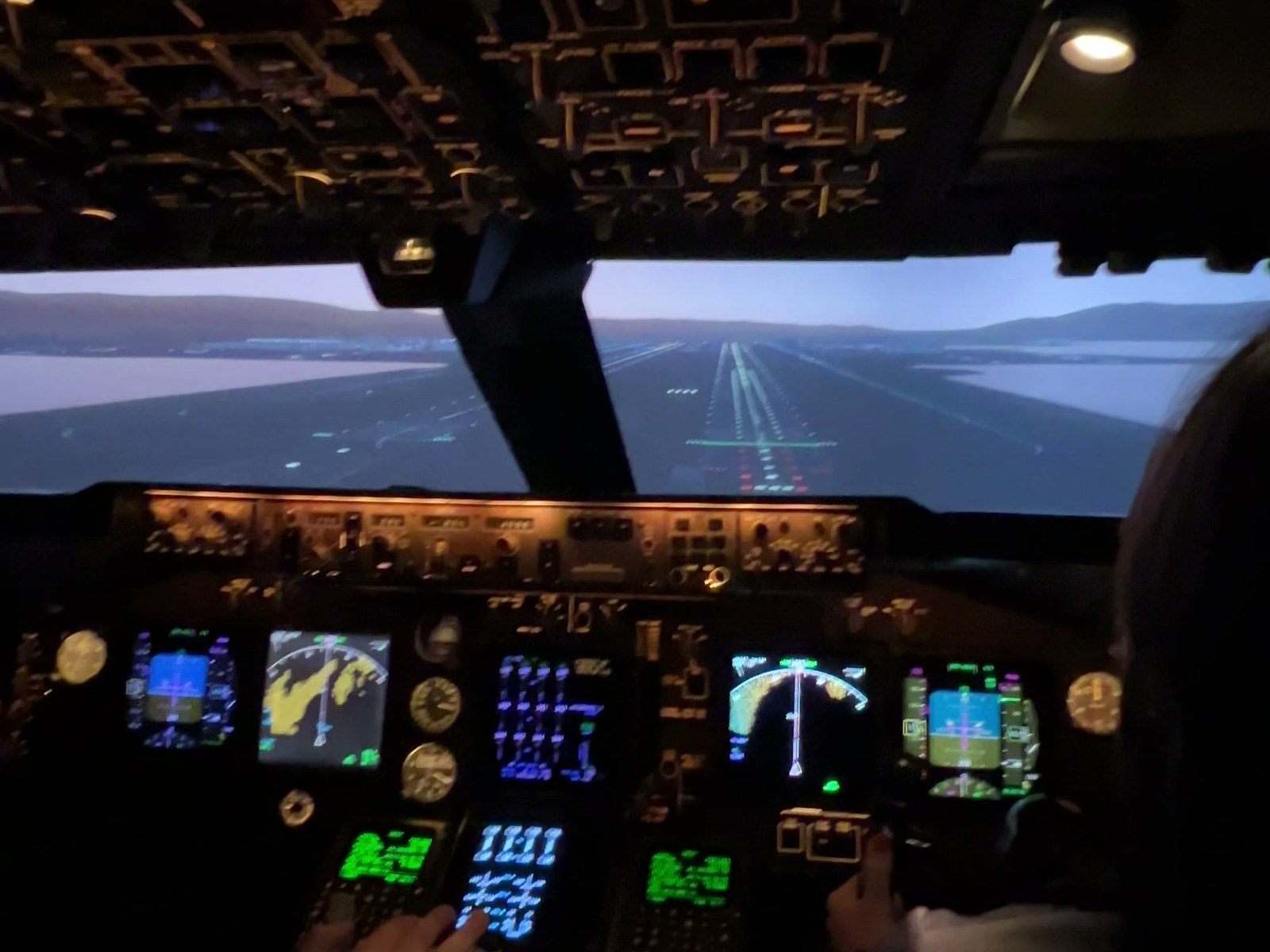
One of the more common questions we hear from pilots headed into an airline simulator evaluation is some version of: “What if I blow the approach?” It is a fair worry. You are strapping into an unfamiliar full-motion simulator, often in an aircraft you have never flown, while someone takes notes behind you.
Here is the part most candidates only learn afterward: evaluators are not grading perfection. Nobody expects a flawless hand-flown ILS — an instrument landing system approach — from a pilot who has never touched that flight deck. What they are grading is trend and correction. Do you notice a deviation early, fix it smoothly, and stay ahead of the airplane? A candidate who drifts half a dot off the glideslope and calmly walks it back usually scores better than one who holds the needles perfectly for two minutes and then unravels the moment something changes.
What evaluators are actually watching
Every airline builds its own profile, and formats vary — some carriers run a screening sim before making an offer, others evaluate you during initial training or a jet-transition course. But across nearly all of them, the grading tends to collapse into four things.
Instrument scan
A jet moves fast enough that fixating on any single instrument puts you behind within seconds. Evaluators watch for a living scan: attitude first, then a steady crosscheck of airspeed, altitude, and course guidance. Fly the attitude and let the performance instruments confirm it — chasing individual needles is the most common way candidates talk themselves into oscillations.
Energy management
A swept-wing jet does not shed speed the way a piston trainer does, and it will not slow down and go down at the same time without a plan. Evaluators want to see you thinking ahead of the airplane: reducing power early, configuring on schedule, and arriving at the final approach fix stable rather than fighting to get there. Being on speed and configured early forgives a lot of small sins elsewhere.
Callout discipline
Standard callouts — “localizer alive,” “one thousand to go,” “stable” — are the short phrases airline crews use to keep both pilots on the same mental page. Using them, even imperfectly, signals that you already think like a crewmember. Silence in the flight deck reads as a pilot flying alone in their own head, and that is exactly what airlines are screening against.
Crew communication
You will rarely be evaluated as a single pilot. There is usually someone in the other seat — another candidate, or the evaluator themselves — and airlines want to see you use them. Ask for gear and flaps by name, call for checklists, verbalize what you intend to do before you do it. A clearly commanded “go around, flaps fifteen” after a bad approach is worth more than salvaging a marginal landing in silence.
The evaluation starts in the briefing room
Most candidates pour all their preparation into the flying and treat the briefing as a formality. Evaluators see it the other way around. How you brief an approach — the weather, the minimums, the missed approach, what you will do if an engine quits at rotation — tells them how you will operate on a line trip long before the motion comes on.
If you receive the profile in advance, arrive having chair-flown it: know the power settings and pitch attitudes you plan to start with, and say them out loud in the brief. If you make an error in the sim, expect to talk about it in the debrief — owning the mistake and explaining your correction is part of the assessment, not an afterthought.
This is why our own training at Air Vegas Services wraps every simulator session in airline-style briefings before and after — focused on procedures, decision-making, and operational discipline rather than just stick-and-rudder mechanics. The habit of briefing well is trainable, and it transfers directly to evaluation day.
Practice in the environment you will be judged in
Desktop simulators and chair flying are genuinely useful for procedures and flows. What they cannot give you is the feel of a transport-category aircraft: the control forces, the inertia, the motion cues that tell you a correction is working before the instruments confirm it. If your evaluation is in a full-motion device, your preparation should include one.
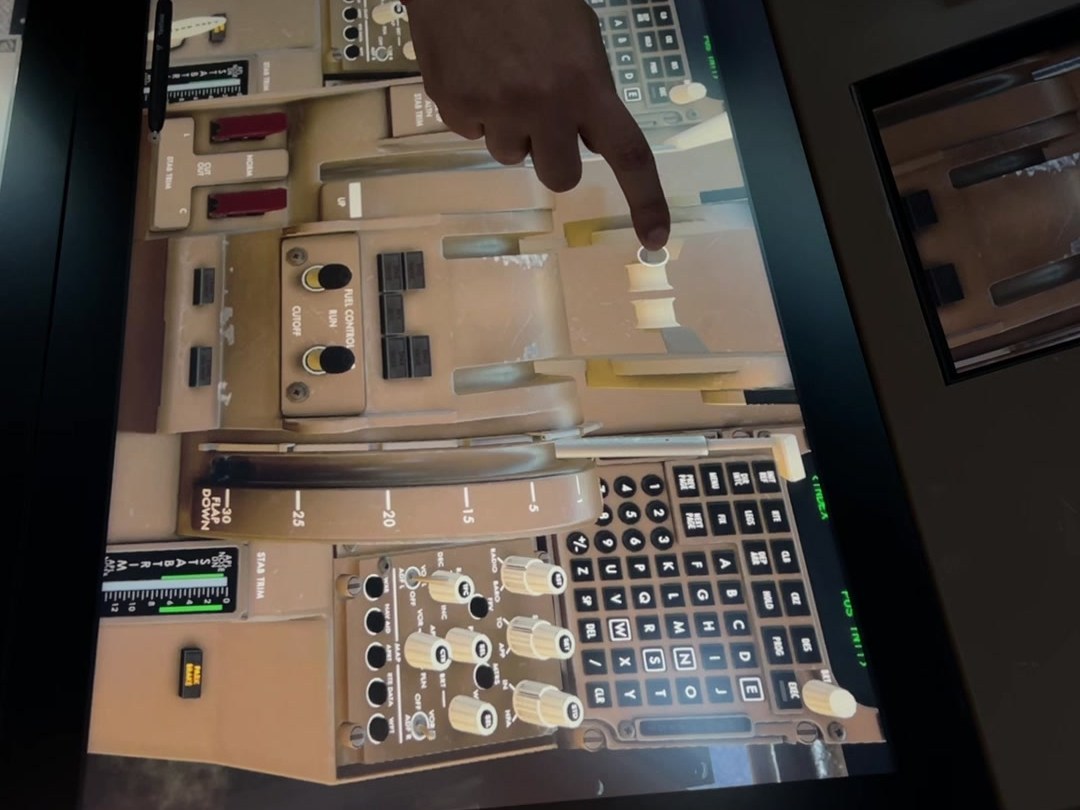
The other advantage of a professional simulator is the operator station behind the seats. An instructor at the console can reposition you to a five-mile final, fail an engine at the worst possible moment, re-run the same approach in worsening weather, and repeat — shaping the session around your weak areas instead of burning an hour flying full profiles to reach the two minutes you actually need to practice. In our full-motion Boeing 737 simulator in Fort Worth, that is exactly how we structure prep time: instructor-controlled scenarios, flown and re-flown until the correction becomes reflex.
It also matters who is sitting behind you. Our instructors are experienced airline pilots with decades of operational experience — people who have sat in the seat you are trying to earn and who know what an evaluator's pen is actually recording.
One honest caveat: sim prep is polish, not remediation. If your instrument scan has been dormant for years, a single session before your evaluation will not rebuild it — you would be better served scheduling several sessions over a few weeks, or being candid with yourself about your timeline. And if you are an international pilot planning to train in the U.S. first, remember that non-U.S. citizens need TSA clearance before any simulator training begins, which typically takes one to four weeks. Build that into your calendar.
On the day
Sleep matters more than one last night of studying. Arrive early, dress like the professional you are asking them to hire, and bring your paperwork organized.
- Fly the first thirty seconds gently. Use the initial maneuvering to feel out the trim and control forces before you need precision.
- Say what you see. “Speed's decaying, adding power” turns a deviation into evidence of a working scan.
- Correct and move on. A mistake is not a failure; dwelling on it for the next three minutes is. The recovery is the data point.
- Take the debrief professionally. Notes, questions, no excuses. Evaluators remember coachability.
Getting seat time before the real thing
The pilots who walk into evaluations calm are almost never the most naturally gifted — they are the ones who have already seen the sight picture, heard themselves make the callouts, and felt a jet respond to their corrections. That exposure is buildable.
If you would like structured, focused sim-prep time in a full-motion Boeing 737 simulator — with airline pilots in the instructor seat and sessions shaped to your weak areas — our training center on Diplomacy Road in Fort Worth, minutes from DFW, is set up for exactly that. Reach out at (817) 747-6577 or info@airvegasservices.com and tell us when your evaluation is. We will work backward from there.