We've watched a lot of pilots come down the stairs after their first session in a full-motion Boeing 737 simulator. Almost none of them talk about the visuals. What they talk about is the workload — how real it felt to sit in a moving flight deck while the checklists, callouts, and decisions kept coming whether they were ready or not.
One of the more common questions we hear from pilots preparing for an ATP CTP course or a 737 type rating is some version of "what's it actually like in the box?" It's a fair question, and the honest answer is more interesting than the marketing version. Here's what your first hour actually looks like — what happens, what will surprise you, and how to show up ready.
Why Airlines Train in Simulators at All
A full-flight simulator isn't there to imitate a nice day of flying. Its job is to let you rehearse the things nobody should ever practice in a real airplane: an engine failure right at V1 (the speed after which you're committed to the takeoff), windshear on short final, recovering from an upset at altitude. In the sim you can fly all of it, get it wrong, talk it through, and fly it again five minutes later.
The FAA is explicit about this. The ATP Certification Training Program — the course required under 14 CFR 61.156 before you can take the airline transport pilot knowledge test for the multiengine rating — puts part of your training in a full flight simulator precisely because the scenarios it covers are too dangerous to fly for real. Airlines go further still: type-rating checkrides are typically flown entirely in the simulator, and at many carriers a new pilot's first flight in the actual airplane happens later, on the line, with a check airman watching.
That should tell you something about fidelity. Regulators and airlines trust these machines enough to certify pilots in them. When the motion platform rolls you into your first turn after takeoff, your inner ear will trust it too.
The Rhythm: Brief, Fly, Debrief
Your session doesn't start in the seat. It starts in a briefing room, the same way it does at an airline: what we're flying today, what the profiles look like, what "good" means for each maneuver, and which threats to expect. At AVS, every simulator session is bracketed this way — an airline-style briefing before you walk down the hall, and a debrief after — because that structure is exactly what you'll live inside for the rest of your career.
Then you strap in. One of the first surprises is that you almost never taxi out and fly a whole flight from gate to gate. The instructor repositions the simulator instead: one moment you're holding short of the runway, the next you're on a ten-mile final in a completely different weather picture. An hour in the box can hold more approaches than a month of real-world flying, and that density is the whole point.
Behind the Glass: The Operator Station
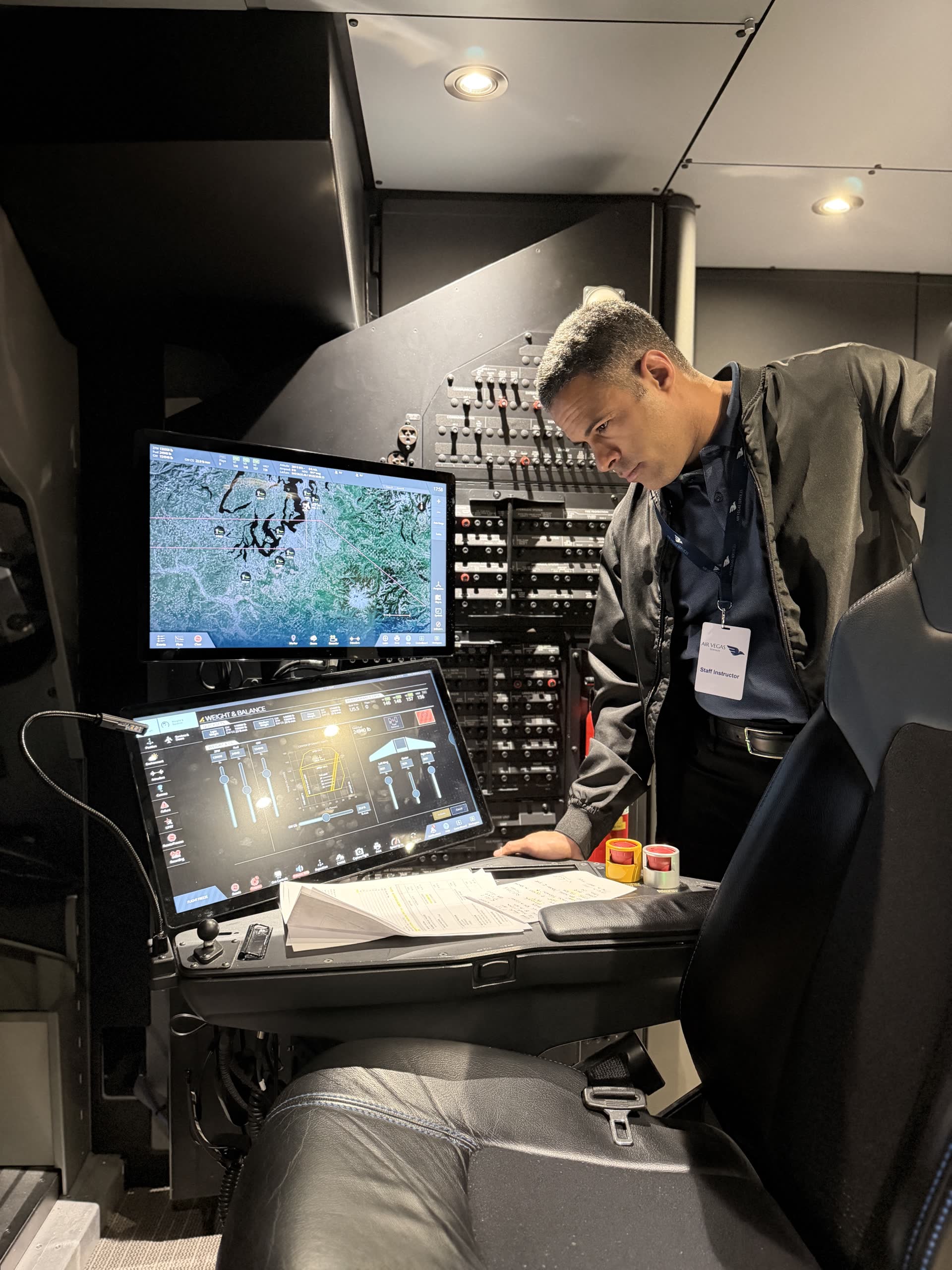
Behind the pilot seats sits the operator station — the screens and controls where your instructor runs the show. From there they set the weather, place the airplane anywhere on the map, freeze the simulator mid-maneuver to talk through what just happened, and trigger failures at precisely the worst moment. That last part is deliberate.
It helps to understand this before your first session: nothing in the sim happens to you by accident. When the engine quits at rotation, your instructor chose that moment because it's the moment the maneuver is designed around. The operator station is what turns a very expensive machine into a lesson plan — and a good instructor at that console is worth more than any amount of graphics.
What Surprises Pilots in the First Session
The motion is subtle — and that's why it works
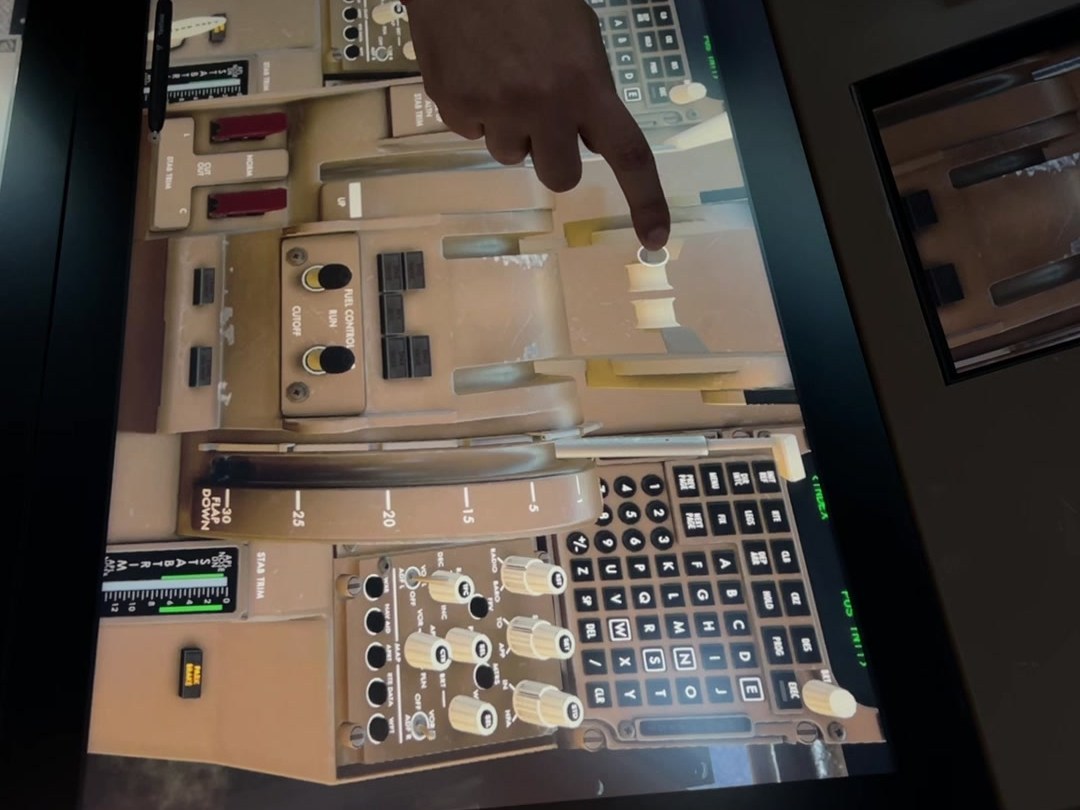
Pilots expecting a theme-park ride get something quieter and far more convincing: the push in your back as thrust comes up, the rumble of the centerline lights under the nosewheel, the sink in your seat as the descent begins. Motion platforms work by pairing small, well-timed accelerations with the visuals, and your brain fills in the rest. Most pilots stop thinking "simulator" within about ninety seconds.
The callouts come fast
Airline flying is flown as a crew, to a script. Flows — memorized patterns of switch and setup actions — standard callouts, and challenge-and-response checklists set a tempo that catches nearly everyone off guard at first. In a piston trainer you run one checklist per phase at your own pace. In a 737 flight deck, the airplane sets the pace, and it doesn't wait.
A turbine airplane gets ahead of you quickly
A 737 climbing away from the runway covers roughly four miles a minute. If you trained in airplanes that cruise at 110 knots, "staying ahead of the airplane" takes on a new meaning: by the time you finish a thought, the situation that prompted it is behind you. Feeling behind in your first hour is normal — everyone experiences it, and closing that gap is precisely what the training is built to do.
Getting the Most From Your Hour
Here's the encouraging part: the pilots who get the most from the simulator did most of the work before they walked in. Three habits make the biggest difference.
- Chair-fly the profiles. Sit in a quiet room and fly the departure out loud — every callout, every flow, every pitch and power target. Simulator time is too valuable to spend learning things a chair could have taught you.
- Learn the flows cold. If you're digging through memory for what comes next, you have no spare capacity left for flying. Aim to know the flows so well they feel boring.
- Treat the debrief as the real lesson. The session shows you what happened; the debrief tells you why. Bring a notebook, ask the uncomfortable questions, and write down what you'll do differently before you leave the building.
One candid note: a full-flight simulator session is not a joyride, and if a fun flying experience is what you're after, an hour in the box will feel like work — because it is work. It's a professional tool for building professional pilots, and it rewards preparation far more than enthusiasm. Also practical: if you're not a U.S. citizen, TSA clearance is required before any simulator training begins, and processing typically takes one to four weeks — our TSA clearance guide walks through the steps, so start early.
And when you're ready to fly that first hour, we'd be glad to run it with you. Our full-motion Boeing 737 simulator is on-site at our Fort Worth training center, minutes from DFW, with the briefing room just down the hall and instructors who are experienced airline pilots. Take a look at our ATP CTP and 737 type rating programs, or call us at (817) 747-6577 — we're happy to answer the "what's it actually like" questions before you ever book a seat.